
BierTalk English 49 - Interview with Driess Janssens, Brewer at Hof ten Dormaal farmhouse brewery, Haacht, Belgium
In this episode of Beer Talk, Markus travels back to Belgium and visits one of the country’s most distinctive and authentic farmhouse breweries: Hof ten Dormaal. Together with Dries Janssens, he explores a brewing world where farming and beer are still deeply connected. What began as a practical idea to make the family farm economically viable has grown into a remarkable brewery built on self-sufficiency, craftsmanship, and a strong sense of place. Dries talks about growing his own barley, wheat, spelt, rye, and hops, running a small malt house on the farm, keeping cattle, and brewing beers that reflect both Belgian tradition and his own independent spirit. The conversation moves from crisp, expressive saisons and dry-hopped blondes to old-style witbier, chicory-infused tripel, and the fascinating world of lambic and blending. It is a story about beer, agriculture, resilience, and the beauty of doing things the hard but meaningful way. A thoughtful and inspiring episode about a brewery where the farm is not just the backdrop, but the heart of everything.
Jetzt Episode abspielen
Direkt-Stream in Studioqualität
Das Gespräch — zum Nachlesen
Markus: Hello, and welcome to another episode of our podcast, Beer Talk. Today I’m very happy to go back to Belgium, one of my absolute favorite beer countries. And I’m very happy to visit maybe the only real farmhouse brewery in Belgium, and of course a great guy. We met just a few days ago because we were together at the Franconian Beer Festival. He was there, we had his beers, and his beers were the first to sell out. So the German guys really liked the beers, and that’s fantastic. I’ve already been to the brewery twice, and it’s also a fantastic place to visit. I hope you are just as curious as I am to hear what Dries Janssens will tell us. So, great, Dries, that you are here. Maybe you say a few words about yourself to our listeners.
Driess Janssens: Hi, Markus. I am Driess Janssens. We have been farmers and brewers since 2009. We started the brewery with a different mindset than many other small brewers. We weren’t big fans of craft beer before. It was a world we didn’t know. We started a brewery to make our farm pay, because I wanted to take over the farm from my parents and they said it wasn’t possible. By brewing, we could expand our income and keep farming. And with that simple idea, we started brewing.
Markus: Yeah, very interesting. I know a lot of people who say, “I want to open a brewery to make money,” but you are the first one I’ve heard say, “I want to make my farm make money with a brewery.” That’s great. So maybe I’m curious first about the farm itself. What does it look like? Let people know a bit. We are a bit north of Leuven, and if we get there, maybe you can lead us a little through the farm. What do we see? What do we find? What animals are there? What crops do you grow? What happens there?
Driess Janssens: So we are a typical mixed farm from the middle of Belgium, which means that we grow small grains now, of course with a focus on brewing. We grow about 12 hectares of spring barley each year for the brewhouse. We also grow about a hectare of spelt, rye, oats, and wheat for the brewhouse. And we have half a hectare of hops, all old German varieties. We grow a little Magnum, a little Hersbrucker, a little Perle, and a little Cascade, which isn’t a German hop, but we grow Cascade too. Those are the hops we use the most in the brewhouse, and the rest we buy in. Then we have cattle too. The amount of cattle we have on the farm depends on how much savings I have, so I use the cattle a bit as a live bank, so to speak.
Markus: So how many are there at the moment, and what kind of cattle are they?
Driess Janssens: There are 25 head of cattle. We used to raise Piemontese cattle, an Italian beef breed, which worked fine with spent grains and malt combs coming out of our malt house to fatten them up. But now we are getting rid of those, and I am raising Holstein oxen, or steers, for their beef.
Markus: Oh, the big ones. Great. And other animals, like chickens or something?
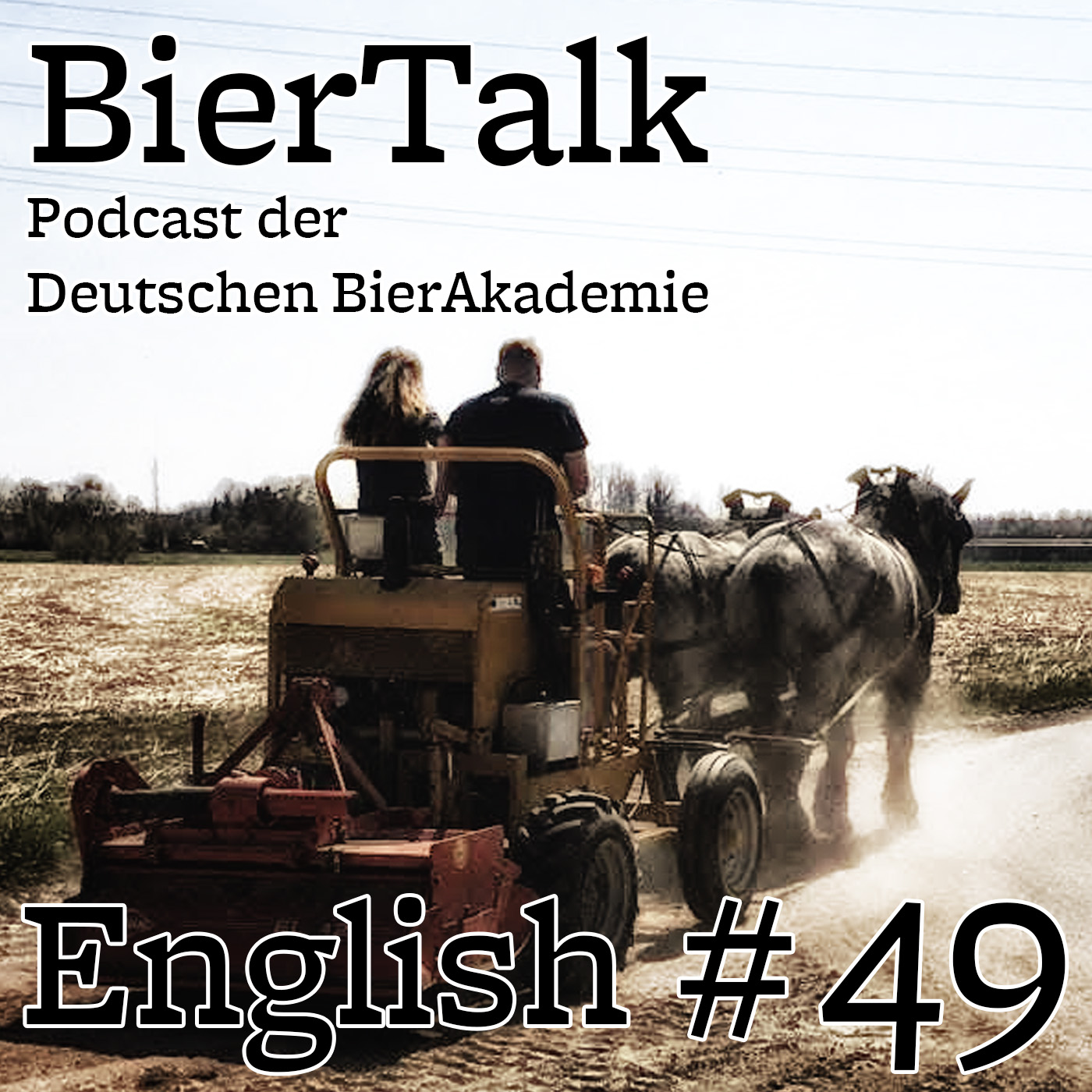
Driess Janssens: So for the moment, two draft horses and three goats. And I’ve always wanted to have pasture-raised eggs, but my wife tells me that first we have to do some other projects, and then I can have chickens.
Markus: It’s always important to have some goals.
Driess Janssens: Yeah, yeah, yeah, yeah, yeah, yeah.
Markus: What I also found really interesting is that you have your own coolship, and it is movable, so you can move it around and use it where you need it. Is it still in use?
Driess Janssens: Yes, but it’s movable. It used to have a nice place on the first floor, where now the malt house is. It sat there for a couple of years, but now the malt house is there, so we moved it out of that place. In the summer it sits outside, because our coolship doesn’t really have a good place to stand at the moment. And when we use it in the wintertime, we put it on top of the brewery, in the attic above the brewhouse. But there is no room there either, so we move it outside again in the summer.
Markus: Wow. So you have your own hops, you have your own crops, which means you also have your own malting, as you already mentioned. And you also work with your own hops. So how do you process your hops? Do you dry them somehow?
Driess Janssens: Yeah, we have a hop-picking machine, a relatively small one, but it’s a machine built in Belgium in the 1960s. I bought it in Poperinge ten years ago and moved it over. So we pick them mechanically, and then I dry them in the malt house, so I can dry grains and hops in the malt house.
Markus: How perfect. Like in England.
Driess Janssens: Yeah, yeah. And then, if I have enough, I can pelletize them, because I prefer pellets in the brewhouse over whole flowers. But if I don’t have enough kilograms — because I need 100 kilos of hops before I can have them pelletized — then I just use them in dried flower form.
Markus: Yes, so you are self-sufficient in hops. And what about the malt house? How big is it, and what malt do you make?
Driess Janssens: So the maltings are two Saladin boxes of two tons of grain each. I make around 80 tons of malt per year in batches of two tons. It takes about eight days to do a batch of malt, and I have two Saladin boxes. So on a big week, I can make a little under four tons of malt if I am running full out.
Markus: Wow, that’s a lot. And do you also sell some malt, or do you use all your malt in your brewery?
Driess Janssens: No, we use about half of it. So I sell some malt, and I also do malting for other brewers or farmers who bring grain, because I am by far the smallest one. It’s me with my two tons per batch, or Dingemans with its 30 tons per batch, and that’s a really big gap. So I have clients who do a few tons of malt each year and bring their barley, mostly. And I make all the base malts. I make everything from distiller’s malt up to Vienna malt. I don’t go higher than Vienna malt.
Markus: So if I count it right, if you have the hops, the malt, the grains, the cattle, and the brewery, normally you would say there are maybe 25 people working. So how big is your workforce?
Driess Janssens: My workforce at the moment is me and my wife. Yeah, yeah. But I see it as a lifestyle. Our life is a lifestyle, and we do the jobs that we need to do. We don’t ask questions; we just do them. And we work long hours and we don’t take holidays and stuff, but I like it like that. I have to say, though, that I just took over the brewery from my brother half a year ago, and before that he brewed the beer. So since half a year ago, I do the brewing too.
Markus: And your wife also comes from a farming family?
Driess Janssens: Yes. You need to have the right mindset.
Markus: Yeah, that’s right. Otherwise you would probably go crazy.
Driess Janssens: Yeah. Otherwise she would go crazy. If I come into the house at ten in the evening, she says, “You’re in already?” And that’s the mindset you need.
Markus: Wow. And if we go back to 2009, what was the process like to start all this and set it all up? How did you come to the conclusion, “Okay, we do it like that,” and then start brewing?
Driess Janssens: Yeah.
Markus: How did that happen?
Driess Janssens: Yeah, it was like this: my father went to Billings, Montana, and he bought a small system there. It was a really good one, American-built, a two-vessel system: mashing and boiling in the first kettle, and then lautering and the hot water tank in the next one. It was a really good system, 1,200 liters each batch. He bought it, we brought it over, and then in fact a Belgian freelance brewing engineer taught me how to brew, and he taught me everything. And that’s how I started. Yeah, and that’s how we took off.
Markus: And it really took off well. You really skyrocketed on all the rating platforms and things like that, I think until the pandemic. So you had a lot of good success with the brewery, hadn’t you?
Driess Janssens: Yeah, it skyrocketed big time. Pure coincidence: right after we started, we found an American importer, so we exported a lot of our beers to the U.S. They liked our beers, and I guess we made good beers too. And yeah, we came into that world of ratings and always brewing something new, which was real fun. Since Corona, that whole world closed down on us, and we transformed into a typical Belgian brewery selling everything in Belgium. So yes, we had a really big transformation since then.
Markus: I can imagine. These are hard times. And you also had, I think, a fire or something in 2015?
Driess Janssens: Yeah, in 2015 our brewery burned down. Not the installation, but the fermentation tanks, the bottling plant, and the stock burned down. Then, a year later, we built a new roof, went to Bamberg to buy a new installation, and put that in the barn. Now we brew on a 2,300-liter system.
Markus: Yeah, very impressive. I saw it myself and it’s really great to see that. And of course, as I already said, to taste the beers. I can really say from my own experience — as I said, I’ve been there twice, and we had you now at the festival — that all the beers are really very good, well thought out, and also interesting recipes, not just classic things. Every one has its special thing, and a lot of work behind it. You really smell and taste the work behind it. So now at the festival, for example, we had two beers: the Saison and the Tinto, which is like a dry-hopped blonde. And with the Saison, for example, I really liked the character because it is a classic saison, but in the finish it has a fantastic dryness and a fantastic bitterness. It’s perfectly balanced, but very expressive. So this is a beer that really tells a story — and a story about the hard work behind it, about all you do to get the recipes right and the raw materials right, and then the beer in the end. How did that recipe come about? Did you try several things, or did you ask someone, or look in books, or did you develop it yourself?
Driess Janssens: The Saison has had quite an evolution. The first time we brewed a Saison, we tried to be purists, and we in fact had a kettle-soured saison. It’s been more than ten years now, because we thought that if you are going to brew a traditional old style of beer, it must be sour, because in the past beers had to be sour. People knew about hygiene, but they didn’t know about bacteria. So we brewed a kettle-soured saison, which was all good until we had some bad batches, because I don’t really like kettle sours. They are good for one-offs, but if you brew through a whole year and try to brew the same beer during different seasons with kettle souring, you get all kinds of different results, and that is a problem. So we stopped doing the kettle sour, and then we transformed it into the really dry saison we try to make now. I do everything to achieve that dryness: through the mash temperatures, through a good start in the mash, and by using the right yeast. I ferment everything quite high in temperature to try to achieve less than 1 degree Plato in the Saison. And because you lose a lot of body when brewing a beer that dry, we use quite a big hop addition to give it something. So that’s why our Saison is quite bitter.
Markus: Yeah, but as I said, in a very nice way. It’s in the finish, and it sets like an exclamation mark on the last sip and says, “Okay, hello, drink me again.” And it’s really, really nice. And it’s all your hops?
Driess Janssens: It’s all our hops, yes. Oh, I forgot — did I say that we grow Hersbrucker?
Markus: Yeah, I think so.
Driess Janssens: Well, the Saison only has Magnum and Hersbrucker in it. It’s a really simple beer. It’s a really simple grist bill. And I just try to do the mashing well. Mashing is really important, I think, in brewing beer. So if you do that well, then you’re all set.
Markus: And sometimes the simplest things are the hardest. But anyway, the Saison is an absolutely great beer, and of course it matches very well with the idea of a farmer’s brewery. I think it is, in the end, the iconic style that matches that. The other one we had was the dry-hopped blonde, or juicy blonde as you say, the Tinto. People liked it very, very much as well. And for me, the hops were really shining in it. You might have thought it used a lot of non-European hops, but it was all European hops.
Driess Janssens: Yeah, but they are all German aromatic hops. For the dry hopping, it’s all Hallertau Blanc, Mandarina Bavaria, and Hüll Melon.
Markus: Okay. Those are very tasty hops, so that sounds like a great combination.
Driess Janssens: Yeah. And if we buy hops, we tend to use German hops all the time — not out of our love for Germany, but simply because I like German hops for their taste and their price.
Markus: Where does the name Tinto come from?
Driess Janssens: Oh, the beer was brewed for our Italian importer, and he is in Turin. He chose the name. It is some kind of poetic contraction between Tildonk, which is the town we live in, and Turin. He came up with Tinto, and since then that has been the name of the beer. But Tinto is also Spanish for red wine, so it is a bit confusing sometimes for people. But whatever — the name is Tinto, and it stays Tinto.
Markus: Yeah, and people had to learn that too. But because we have this winey character a little bit from the Hallertau Blanc, I think that is absolutely okay. It is a very complex beer. It has this fruity and a little winey part in it, and also a nice, crisp body. So what malts are you using for it?
Driess Janssens: The Tinto has a little Munich malt in it. It has Pilsner malt for the main part, wheat malt — and in fact all our beers have a little addition of wheat malt. So it is Pilsner malt, wheat malt, Munich, and a little pale malt, all malted by ourselves.
Markus: What about the other beers? What other beers do you brew, and how much do the traditional consumers appreciate them?
Driess Janssens: So, for the moment, we also brew a tripel, which in Belgium you more or less have to do — because we are in Belgium. But it is a tripel with chicory roots in it. So it does not contain a lot of hops, but a lot of chicory root. Chicory roots are also very bitter, and they color the beer a bit, so it is a bit of a dark tripel-style beer. That is one of the beers we brew at the moment. We also brew lambic in the wintertime. And we brew a mix of beer and apple juice that we ferment together. Then we get a very easy-drinking beer, which we ferment with Champagne yeast, and then you get our answer to sparkling wine.
Markus: Absolutely, I had that.
Driess Janssens: Yeah. And a stout from now and then. But stouts are a bit problematic in sales at the moment, so it will probably be a while before we brew a stout again.
Markus: If you go back to the chicory beer, as far as I remember chicory was used to replace coffee. So is there some of that aroma in that beer?
Driess Janssens: Yeah, if you roast chicory, you can use it to replace coffee. We still use it, by the way, a little bit when we make coffee here at home. It’s kind of the same product. But we use the raw roots, which we put in an oven to dry, and then you get the caramelization too, just like with burnt chicory roots for coffee. It’s a bit the same, and so you get a bit of that aroma in the beer too. Yeah, we have brewed it for a very long time: White Gold.
Markus: Yeah, that’s very interesting, also in terms of the concept of using the whole plant, because you can use the top part, the leaf, let’s say, and sell it as a salad. And then you have the root and you can make beer out of it. That is a perfect way to be sustainable.
Driess Janssens: Yeah, yeah. We get the roots from chicory farmers as animal feed. Once they have grown the vegetable on it, they sell the roots to cattle farmers as animal feed. So we use those.
Markus: I think I also remember that when I was there last time, you had this original witbier. I think it was called Bouts or something like that.
Driess Janssens: Yeah, Bouts, yes.
Markus: And what was really interesting for me is that it is the witbier that was there before Hoegaarden was there — so before Pierre Celis put orange peel and coriander and all these things into the beer. It is a totally different recipe for witbier, but it is very, very nice, very drinkable. So how did you decide to go that way with witbier?
Driess Janssens: Well, there is something like this: we are close to Leuven, and Leuven used to have — or still has — a wheat beer tradition. But a wheat beer in the old sense is really just a wheat beer.
Markus: Right, of course, yeah.
Driess Janssens: Or a Weizen, let’s say. The modern wheat beers in Belgium are brewed with a lot of rice, with a lot of coriander, and with a lot of orange peel to make that distinct flavor. But the old wheat beers used to be wheat beers, just like Weizen beers. So they are completely different beers. Top-fermented, yes — and Weizen is also top-fermented. So it has nothing to do with the coriander and the super-low body from the rice and all that. It is just a wheat beer.
Markus: Yes, and very drinkable. I really liked that. It was really interesting because we have a lot of breweries that make modern beers and forgot about the roots. And there we have something that brings us back a bit into the original wheat beer history of Belgium, so that is a really great thing. And you were also talking about the lambics and about the gueuze. How do you do that? Do you also have these very big wooden barrels and vats and things like that, or how do you do it?
Driess Janssens: Like the other gueuze brewers, I guess, in the winter we brew lambics. We have 150 oak barrels in storage and five foeders of 2,800 liters. So every winter I brew, and I fill up the ones that are empty with new wort, and we make lambic like all the other lambic brewers. By the way, I really, really, really like working with lambic. That’s maybe my passion. I really like lambic brewing. I like the complexity of it, I like the blending, and I like how every barrel has its own culture in it and its own taste, and how you combine different barrels to make the beer you like. That’s my cup of tea.
Markus: Yeah, it’s a bit like that if you talk to Frank Boon. He also says each barrel is for him like a person, with a special character and a special result, and he tries to bring them into a good conversation, let’s say it like that. So I think blending is the hardest thing, isn’t it?
Driess Janssens: Yeah, but it only looks hard, because if an outsider comes into a barrel storage, they see a hundred barrels and then you start talking about blending this and that, and they are completely overwhelmed by what a lambic blender tells them. But I know my storage, you know. When I come in there, I know which barrels are really good, I know which ones are a bit problematic, and I know which ones I have to leave for another year because they are really problematic. And if you are there often, you know which barrel is which. And it’s true, it is like a conversation. There are barrels I really love and barrels I really hate.
Markus: So it is like having an orchestra.
Driess Janssens: Yeah, yeah.
Markus: Bringing them together. Yeah, that’s really interesting. And we could also try some of your lambics, and they were fantastic too. It’s a totally different world of beer if you come from a region like Franconia. I really had to learn to enjoy and appreciate it, but now I do. And it’s really great that we have that in the world of beer and that we still have it. So that’s really great. When you were here in Nuremberg, how did you see the beer scene here and the people here? Did you think they were all crazy Germans drinking liters of beer? How did you see them?
Driess Janssens: Yeah. Well, it was the first time I went to a German beer festival, or maybe even only the second time I had been to Germany. In the beginning I was really overwhelmed by the fact that I drank half-liters and even liters. But in the end, it’s just like a Belgian beer festival where we drink 15 centiliters. There was no drunkenness, you know, so it was also about tasting, and I really liked that. And I really found out that the German beer culture is basically unknown in Belgium, just like vice versa, I guess. There are almost no German beers to drink in Belgium, so I didn’t know anything about it. And I was really, really impressed by the crispness, the cleanliness, and the quality of the beers I drank there. They were almost all lager beers, which is Franconian brewing, I guess.
Markus: Yes.
Driess Janssens: I really, really liked them. Just the quality of them. Yeah, I was really impressed.
Markus: Did you find something there that you now think of maybe making in Belgium and giving a try?
Driess Janssens: Yeah, I’m researching a good pilsner. We never brewed a pilsner or a lager beer in the history of the brewery, because lager beers are cheap in Belgium and usually left to the big breweries. But now my brother has his own taproom and I have my own taproom, and he is always asking for a lager. I didn’t really want to do it, but now I’m thinking of brewing one.
Markus: He made it. Fantastic. That’s great. So if we come back to Belgium, and back to your place: if people come for a visit, there are two places they can go, right? One is the farm with your taproom and the lambic storage, at least at the moment. And then there is your brother’s location, which is another farm, or a renovated farm?
Driess Janssens: Yeah, my brother’s location is like a renovated farm. There is no farming activity there, but he has conference rooms for rent, bed and breakfast, and a nice bar, where you can eat spare ribs and stuff.
Markus: Oh, so I can stay overnight. That’s good.
Driess Janssens: Yeah. And you can stay there overnight. And here at the farm is of course our tasting room with no food, and then also our beers, the brewhouse, the malt house, and the storage of the gueuze beers, or the lambics. In about a month, it should all be at my brother’s place, so there we are going to store all the lambics.
Markus: Okay. That will probably be impressive. If people want to visit, do they have to book or reserve a time or something like that, or can they just show up?
Driess Janssens: People can just show up on the weekends, in the afternoon, on Saturday and Sunday. But if you want to do a tour, you should email me or contact me, because I’m in the bar on weekends with my wife and I cannot do tours unannounced, because then I may simply not have the time. Or it can happen that the bar is full and I don’t have time...
Markus: ...which means it’s good.
Driess Janssens: Which means it’s good. So if you want a tour, you’re very welcome, but I prefer it if people ask upfront, of course.
Markus: And we can also buy some bottles and all that stuff?
Driess Janssens: Yes, all that stuff is possible.
Markus: Fantastic. So I will put the link in the show notes and of course the contact data and everything. Thank you very much for your time, for this little virtual visit to the brewery, and for all your work and effort in doing this — and of course for your beers. I can only emphasize again that it was the top beer at our booth in Nuremberg, and that is great. People really enjoyed it. Keep on doing that. Thank you very much, and see you soon again.
Driess Janssens: Yes, for sure. Thank you, Markus.
Gefällt dir BierTalk? Werde selbst Biersommelier.
Das Wissen aus über 280 Folgen gibt es auch als zertifizierte Ausbildung — flexibel online, mit Markus Raupach und dem Team der Deutschen BierAkademie.