
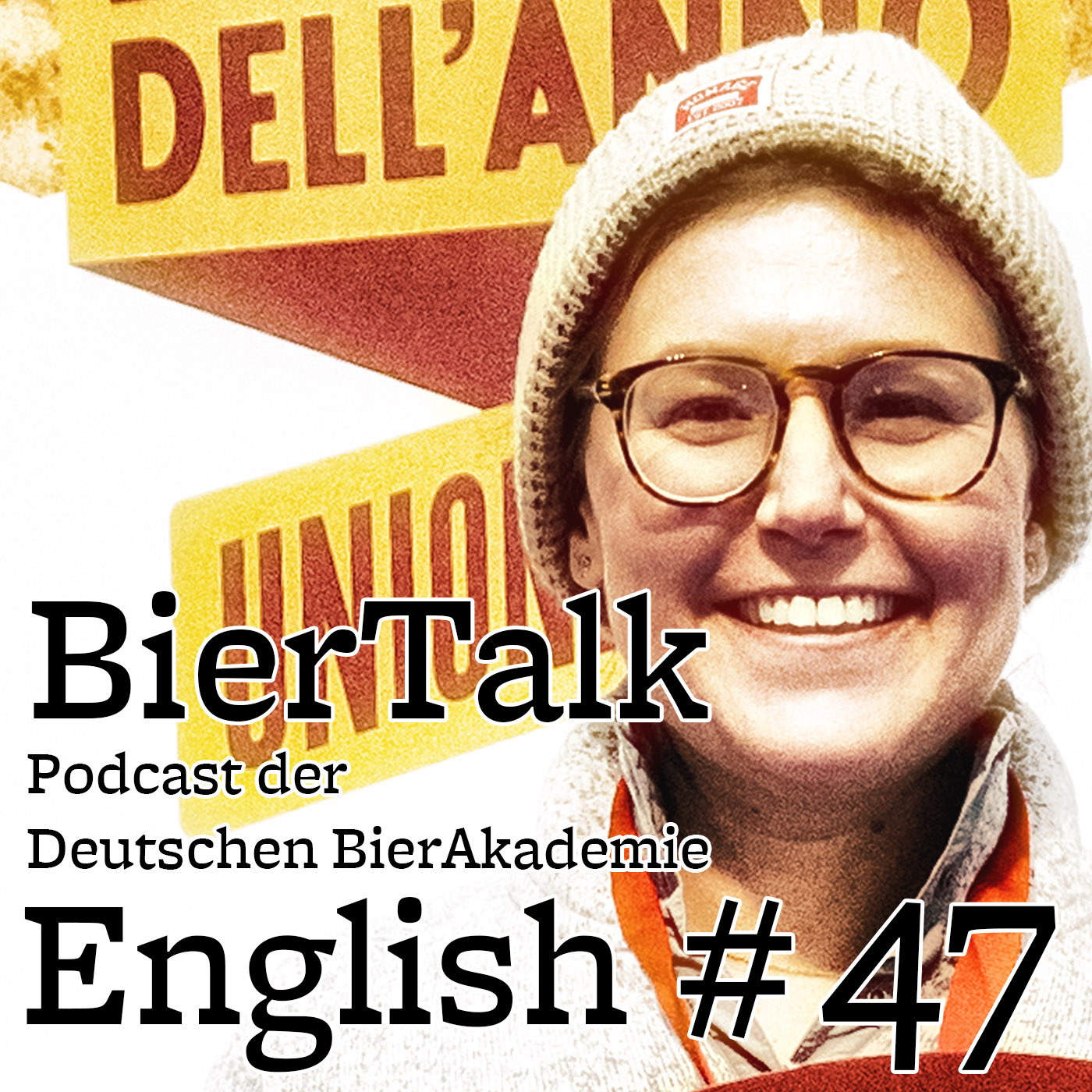
BierTalk English 47 - Interview with Em Sauter, "Bob Ross of Beer", Journalist and Founder of Pints and Panels, CT, USA
In this episode of Beer Talk, I sit down with the wonderful Em Sauter, longtime friend, beer judge, illustrator, and the creative mind behind Pints and Panels. It’s a conversation I enjoyed immensely — not least because, somewhere along the way, I seem to receive my very first declaration of love in a podcast. That alone makes this episode one for the books. But beyond that unexpected highlight, we talk about Em’s fascinating journey of bringing together two great passions: drawing and beer. We explore how she went from cartoonist to one of the most recognizable visual educators in the beer world, and why illustration can sometimes explain beer better than a thousand technical words ever could. Along the way, we wander through stories about baseball, travel, beer judging, the international beer community, and the many ways beer culture changes from country to country while still connecting people everywhere. And because Em never stands still creatively, we also talk about her growing interest in wine, cocktails, and whisky, and how Pints and Panels is evolving beyond beer. It’s a warm, funny, and very personal episode about creativity, curiosity, and the joy of finding your own voice — with a few laughs, a lot of heart, and at least one memorable podcast first.
Jetzt Episode abspielen
Direkt-Stream in Studioqualität
Das Gespräch — zum Nachlesen
Markus: Hello and welcome to another episode of our podcast, Beer Talk. Today I'm very happy to welcome a longtime friend of mine. She's also a beer judge, and we always seem to meet somewhere in the world. It's quite funny because normally she's in the U.S., but right now she's in Italy, so the timing works perfectly. It's wonderful to have you here. Welcome, Em Sauter. Maybe you can say a few words about yourself.
Em: Yes, thank you, Markus. Hello everybody. My name is Em Sauter. I'm the founder and cartoonist behind the website Pints and Panels, which is a drinks education website that mostly teaches you about beer. I recently started doing cocktails, spirits, and wine as well, just to strengthen the brand. I'm based in New England, in the northeastern part of the United States. And I love you, Markus. I'm so glad we get to chat.
Markus: Fantastic. We could stop right now. It's perfect.
Em: Yes. We're done. We're done. See you later.
Markus: Thank you.
Em: Fantastic.
Markus: The question I had when I thought about our chat today was this: if I think back to my own life, I'm not really sure what came first, drawing or drinking. What about you?
Em: I started drawing when I was four, so I feel like drinking probably wasn't on the table until I was at least 15 or 16, if I'm being honest, secretly swiping alcohol from somewhere. You know, it's America, so you couldn't drink until you were 21, but that didn't stop us. But no, I remember really enjoying drawing when I was four. I actually have a real core memory of drawing my first person. I was in preschool, and I had an invisible friend named Peter Dream—don't worry about it. He was waiting for the bus, and I drew Peter at the bus stop. My mom used to have it hanging in our basement. I wish she still had it, but that was 1987. As long as I can remember, I've been drawing. My style kind of evolved out of reading a lot of Archie comics when I was 11 at summer camp and then trying to draw those characters. That eventually helped me create my own style, and I've just been drawing ever since. It's also something I don't think I'm particularly good at. And I'm not saying that so you'll say, 'Oh yes, of course you are.' No, no, no. I just mean artists have limitations, and I have a fair amount of them. But I really think you can use those limitations to your advantage. You learn what you're good at. And apparently I can draw a pint glass, so there we go.
Markus: Perfect. And when did the idea start to do this professionally, drawing in general?
Em: I went to art school for two years, from 2009 to 2011. I was in Vermont, and at the time—so this was around 2010—Hill Farmstead had just opened. Around then, a lot of breweries in the U.S. were still big regional players. I lived in White River Junction, and the school was only about half an hour from Long Trail, which is a very big brewery in Vermont, and about 20 minutes from Harpoon, which has a Vermont facility as well as a Boston facility. I spent so many hours driving out to get growlers. I loved UFO White, which was kind of their—well, I don't even know exactly what UFO White is. It's like an American wheat ale, but it's also a witbier. It doesn't fit neatly into one style. I haven't had it in years. But we could get a growler of it for six dollars, so four pints. I loved going there. They had a really good restaurant, and I really enjoyed all the beer. I remember when Firestone Walker went into New Hampshire, right next door, in 2011, and then we had access to Dogfish Head too. A lot of the beers we were drinking were either bigger regional beers like Dogfish Head or similar breweries. I mean, oh man, I used to drink my weight in 90 Minute at art school, especially because it's pretty high in alcohol and, you know, you're a poor artist. I was driving around in May 2010 and thought, I want to do a beer website where I review beer and say what I like and what I don't like. It was actually my art-school boyfriend who named it Pints and Panels. He just said, 'Oh, you're going to call it Pints and Panels.' I'm very, very appreciative. I owe him multiple dinners. He's a very nice guy. But yeah, that's where Pints and Panels started. Then it became part of my senior thesis when I graduated from the Center for Cartoon Studies. And I just kept at it. That's the thing, I think: the resilience of it, the never-give-up attitude of just reviewing, reviewing, reviewing. I did beer reviews for nine years before I switched to education. People would always say, 'Oh, you should do education, you should do education.' But you can't tell people to do something until they actually want to do it. I found that when I was studying for the Master Cicerone exam, having a visual component—which really didn't exist—was incredibly helpful. So I thought, I should share these with people and put them on my website for free, so other people who want to study can use them. Then during COVID it really took off, because everyone was at home, and I was so surprised by how people responded to it and really enjoyed it. And now it's my full-time job. I wake up every day thinking how lucky I am to be, one, in the beer community, which is just a fantastic place, and two, to have people really enjoy what I create. As an artist, in any cultural medium—music, art, whatever—to have people truly enjoy what you do and say thank you is amazing. I'm getting emotional just thinking about it, because I'm so happy with how this has all worked out. And then I get to judge beer competitions with you, Markus, and we get to go all over the world and try amazing beers and see really cool things. It's afforded me so much. I mean, I'm in Italy right now for Birrificio Italiano's birthday party, and just being in that room with some of the founders of Italian craft beer and seeing all they've done for Italy—and being invited—was incredible. It's a community I'm very happy to belong to.
Markus: And I can only say it's fantastic to have you there. I think there are so many interesting components to the whole story. You started with drawing, you fell in love with beer, those two things came together, you made these wonderful beer cartoons, and then you also got into professional knowledge about beer and judging beer. It all comes together in these great cartoons. And of course people discovered that, because the beer world was looking for something like that. We didn't really have visual education in that style, in that nice and approachable way. So of course it took off, and it's fantastic. We use it ourselves, so I can say that firsthand. It really is great, and it takes you to interesting jobs, places, and experiences. That's really amazing. But can you remember when you fell in love with beer?
Em: Oh, of course. That's another core memory. It was 2006. I had Sam Adams White Ale, their take on a witbier, and I had never had a witbier before. I was at an Irish pub in Keene, New Hampshire, which is a small town in southern New Hampshire. At the time I was a sports writer right after graduation. I thought I wanted to be a sports journalist, but the pay is awful, sports happen at night, and I really like sleeping. I wouldn't go to bed until two in the morning every night. It was awful. Anyway, I ordered the Sam Adams White Ale. It came in a 25-ounce mug, so well over an imperial pint—about 750 milliliters—and it cost $4.50. I took one sip and everything changed. It was almost religious. I'm not joking. I thought, I will devote my life to this. My first book is dedicated to Sam Adams White Ale. They don't make it anymore. It used to be their spring seasonal, and now they make something related as White Christmas, which is their Christmas beer. It has nutmeg in it, so it's more Christmassy. It's still quite good, though on the sweet side. I think I had four of them. I drank, I don't know, a truly ridiculous amount of that beer. It was snowing, the Super Bowl was on, and I just remember thinking, wait, I'm 22, right? No—2006—I was about to turn 23. And after that I thought, what else is like this? That's the thing: when you discover a beer you really like, you think, okay, I like this, what else is like that? Then I had Hefeweizen, then Belgian styles, then tripels. I remember buying Chimay White in 2007, and it was like 11 dollars for a 750-milliliter bottle. I thought, 11 dollars for a beer? What kind of blasphemy is this? But at the same time I thought, this is fancy and I want to try new things. And it was so good. Belgian beers were really the first gateway for me. Then you start getting into other styles. And the final frontier for me—which is funny, speaking to you in Bamberg—is that I really struggled with Rauchbier until relatively recently. I really didn't like it, and now I really, really love it. That's the great thing about beer: there's a beer for everyone. People say, 'I don't like beer,' and I'm like, no, you do. There's beer that tastes like chocolate. Come on. Beer has such a wide variety of flavors, alcohol levels, styles, processes, and aromas. There's something for everyone. I truly believe that. My husband likes beer, but I actually love that he doesn't work in beer. He works with computers. He really wanted to be here in Italy, but it didn't work out. He likes coming to beer places, but he doesn't like going to beer events all the time. And it's actually really nice that when I come home we don't talk about mash pH at night. I just had breakfast with a Danish brewer, and we spent the whole breakfast talking about Nelson hop selection and timing, and my husband would be like, okay. There's a very good brewery near my house called Dead Language. It's run by a husband-and-wife team, and Chris, who owns it, leans into European styles—a lot of lager, and some British styles as well. We had a very long discussion about mild malt, and my husband was just on his phone. I was like, wait, we can't keep talking about this anymore, I feel bad. It's nice, though, to have someone at home who's incredibly supportive. I wasn't home last year for four months out of the year—maybe even more. We don't have kids, and the cats may miss me, I don't know. But I'm always like, are you cool with this, with me being away? And he's like, oh, he loves it because he gets the whole bed to himself, and he can eat whatever he wants for dinner and I'm not bothering him. But he does get to drink a lot. Samples come in, or I bring home beer, and he's always excited to try them. We have a beer fridge in our basement where he has a shelf. He's allowed to drink anything on that shelf. And if he touches my shelf, I will leave him. There are special beers that I'm saving, maybe for a friend who's visiting or as gifts for someone else. So he has his own beer shelf, and I always make sure it's stocked with things he really likes. He'll drink almost anything, actually. Again, he's incredibly supportive. To have someone in your corner saying, no, you're doing what you want to do and I'm proud of you—that's really lovely.
Markus: That's absolutely great. What I was curious about, since we're talking about being a sports journalist: I had a period in my life when I was a sports photographer.
Em: Oh really?
Markus: And I always loved being right there at the court, taking those pictures, catching the right moments, being so close to the players, in the locker room, or afterward at the parties and everything. You're very close, you get all the emotions, and of course you also have your team that you're supporting. When you're that close, it's a great experience. It was quite hard for me to leave that, though I'm not sad about it. But I know it was a really great time, full of emotion and a huge amount of fun. And maybe in my heart I never left it completely. So what about you? Are you still a sports addict?
Em: Baseball is my sport. I love baseball. The season goes from March until November, so it's most of the year. I'm a Red Sox fan from Boston, but I'm also a New York Mets fan. That's the team I was raised on. And then I became a Red Sox fan in 2000. The thing about becoming a Red Sox fan is that it's very similar to becoming a beer person. The game was on—it was the postseason, the playoffs—and a friend had put it on the TV while I was having a party at my house. So yeah, I was 20. The game went into extra innings, and one of the Red Sox players, Trot Nixon, hit a walk-off home run, which won the game. And I was like, oh, I'm a Red Sox fan for life. I don't know what it is, but there are just things in your life where you meet someone, or have something, or see something, and it completely changes your whole worldview. Then you're like, oh, this is it. It's kind of nuts how that happens to me. Not that often, but the things that are very important to me tend to come from very big split-second decisions. And now, even though I'm in Italy and haven't watched the game yet, I'll watch it tonight. I watch every Red Sox game. I firmly believe everyone has what I call a meditation—something that makes you calm and happy. On my way here, my flight got delayed, so the airline put me in a three-hour taxi to New York City to catch my flight to Italy. My driver and I had a very long discussion. He was a very nice kid—shout-out to Raymond—and he told me that riding his motorcycle is the thing that makes him happiest. And I was like, well, this is when I'm happiest too: either when I'm traveling or when I'm watching baseball. It's something that calms you, relaxes you, and makes you feel good. Beer does something similar. Obviously it's alcohol, so there are differences. But no, I really do love baseball. Speaking of that, have you judged with Carlo Graciano, the Dominican judge?
Markus: I think so, yes.
Em: He invited me to his home in the Dominican Republic, and he took me to a Dominican baseball game. I cried because it was so incredible. The game is the same, but the crowd is so loud. There's this guy carrying a bucket of Presidente lagers, and they're two dollars each, and they give you a napkin to hold the beer so your hand doesn't get wet—which doesn't really work, but it's very charming. And there's bottle service, so you can buy a bottle of liquor at the baseball game and they give you a cooler with ice and mixers. So there are people just sitting there with bottles of Jack Daniel's at the game, which is insane. The game went into extra innings—it was in the 11th—but Carlo had brought a friend with us, and their daughter was exhausted, so I was like, okay, we have to go. And there was still a line for alcohol. In the U.S., you can't buy alcohol past the seventh or eighth inning, and there are only nine innings. Not in the Dominican Republic. The game was still going, and there was still a line for drinks. I thought, wow, okay. All right. Sure.
Markus: They party the whole day. Why not?
Em: They do. It's that Caribbean lifestyle. It's great. And yes, the Dominican Republic was wonderful, because it's fun to meet people through beer and then experience their culture through beer, and see how beer shapes them. Carlo owns a brewery in Punta Cana, so we tried all his beers. And then going to see you in Bamberg and trying different beers there, learning what people like and don't like, what's popular—it's just such a joy. Such a joy.
Markus: I can only agree. It's so great to discover the world this way, always with people who are nice. You're never a tourist, you're always a friend, almost like a family member. That's really wonderful. Maybe back to drawing: how does a drawing start for you? Is it in your brain? Is it in your hand? Is it something that just happens? Or do you think about it before you start?
Em: Usually I draw on the iPad. I switched four years ago because I got diagnosed with wrist tendinitis, and my physical therapist said you'd change the motion of your hand if you switched to the iPad—and you do. My art has actually improved. To me, the work looks a lot cleaner, so I'm very happy about that. A lot of ideas come when I drive, or when I'm out running, or doing chores, and then I always write them down in the Notes app on my phone. I have a note that's basically just called ideas to draw. Then either I get too excited and push aside everything else I was supposed to do so I can work on it, or I post it immediately. I'm an incredibly impatient person. I work incredibly fast, mostly because I'm always like, what's next, what's next, what's next? I can't help myself. That's just how I've always worked. I'm trying to be more patient.
Markus: That's a tough thing.
Em: I don't know if I'll ever get there. We'll see. But normally I draw when I travel. I have a travel iPad that I use on the road, so I can draw anywhere. It's smaller. Then I upload everything into Photoshop, where I clean it up. My website has a backlog, so I always have six or seven months of finished things ready to go. There's so much work that's already done. I mean, there are thousands upon thousands of things I've drawn. Or maybe not. Maybe not thousands and thousands.
Markus: A lot.
Em: Let's just say a lot. That's normally how it works: I'll think of an idea, write it down, or, if I'm home, draw it immediately, then upload it, clean it up, and either post it right away because I think it's too good an idea to wait on, or save it. Conversations with brewer friends or other people also inspire me. I was talking to a friend of mine who owns a brewery in New Hampshire—my friend Mike—and I was rattling off all these things that people in the industry want in brewing, and I thought, oh, I have to draw that. It's really nice to be inspired by brewery or industry friends. I love when people have suggestions. One of the best recurring posts I've done over the past two years—the Guinness blends one—was actually suggested by a follower who said, you've never done this before, you should do it. And it gets a lot of likes. Most Guinness-related things do these days, because it's so popular right now. But it's also really cool how things are differently labeled in different places. Beer is so cultural. It's beer, it's only a few ingredients, but things are called different things in different countries. And Pints and Panels has a pretty global audience. Fifty-five percent of my followers are outside the United States. So there are things where people say, well, where I live we call it this. For example, a snakebite: in the United States, a snakebite is Guinness and hard cider. But in the UK, a snakebite is hard cider and lager. So all the comments are like, you're wrong. And I'm like, I'm not wrong, it's just regional. Something I have to keep checking in myself is that my work naturally leans toward an American bias, just because I'm from the United States. I don't mean to, but I also think there are a lot of right answers in beer. I mean, how many different ways can you brew a porter and it's still a porter? It's fun to have conversations with people who say, where I live we call it this, or these styles are really popular here. In Italy, for example, they love bock beer, and that's so charming to me because we don't really do bocks in the United States. Czech beers are having a huge moment right now. British styles are too. And kind of a throwback '90s style that's having a moment in the U.S. right now is amber ale—the resurgence of amber ale, of all things. Sure, why not? But it's fun to see how different countries interpret styles. I'm from New England, the originator of the New England IPA, and I know how we make our New England IPAs—especially in New England they're pretty sweet and full. But when you go elsewhere, in Italy for example, they're usually drier. I judged the medal round last year at Birra dell'Anno, and it was the same thing on the West Coast: hazy IPAs tend to be drier and more bitter, but they're still hazy IPAs. So there are a lot of right answers in beer, I think.
Markus: Yes, and I think that's a main topic I often have in discussions at competitions. Especially with younger or less experienced judges, they tend to see the world in black and white: this is the right porter, this is the wrong porter. But if you really look at it, there is a lot of gray in between. You cannot really say something is one hundred percent this and zero percent that. There are so many things in between. I almost never say, this is totally wrong, or you are wrong, because it's usually not like that. There is truth in many things. Beer can be so diverse within a style or within an idea. And if you have people from different cultures and countries, they all bring their own personal bias and experience. If something feels right to them, you can't simply say it's wrong. It's just their experience, a different way of seeing a beer style or a concept. Then you can talk about what might be the historical idea, or the framework of the competition, or your own personal interpretation—but that doesn't exclude the other idea. It still has its right to exist. So I think we also learn a lot about respect, being respectful with each other, and discovering that the world is diverse in its people, but in the end we are all humans, and most of us like beer. Maybe that's what unites us. Talking about that, you also work a lot internationally. One thing I really adored was that you made a Duvel glass some months ago. Maybe you can tell us how that came about, how you designed it, and what it felt like to hold it in your hands for the first time.
Em: Yeah. I know the rep and beer educator for Duvel, a guy named James Tai, and I do some events for them in New York City. I got an email from Brian Reams, who's kind of the chief marketing officer for Duvel USA. They're based at Boulevard in Kansas City. Every year they do a different artist glass, a special edition. It's available through the Duvel shop in Belgium—I know because someone showed me a picture of it—and I believe you can also buy it online. People were asking me about it. It was just such an honor to work with them. It was really fun. I actually designed a different glass first, with dogs and cats drinking together in a Belgian beer café. And I thought, this is what I want, because it was right after the 2024 election and I wanted something like beer brings us together, let's not lose sight of what's more important. So I drew this scene with dogs and cats living together—you know, like in Ghostbusters. But they said, you're a beer educator, this doesn't educate. And I was like, no, let me draw animals.
Markus: It does educate.
Em: Yeah, it was really charming. But the Belgians really wanted something educational, and they had an idea in their head, so I was like, of course, whatever. And I'm really happy with how it turned out. It looks really, really nice. They threw a party for the glass in New York City, and I got to hold it for the first time and drink from it. I had one too many Duvels, I'll just say that. I remember being on the subway back to my hotel in Times Square, holding the box I designed with the glass I designed in my lap, just thinking, wow. The thing is, I still haven't really seen it in the wild. I never saw it in one of my local shops in Connecticut. They had it at Whole Foods and some other shops, but I never personally stumbled across it. What I loved was when people sent me photos of it in shop windows. I have a friend in New York City who'd text me like, it's at this bodega on 32nd Street—or wherever it was—and I'd think, okay, cool. People were really responding to it. They really enjoyed it. That's how it came about. They emailed me about a year before it came out, and then it was released in the fall of last year. I put two of them in my suitcase. I gave one to my mother, and I kept the other one.
Markus: I think for me that must be a real goosebumps moment. If you think back to the first day you started drinking beer and drawing, then entering the beer world, traveling for beer, doing competitions, and then ending up designing a beer glass for one of the most iconic Belgian beer companies—that's incredible. And it goes on and on. As you said at the beginning, it's a very special thing to look back at your life and see how things evolved, and to get that kind of feedback right away. I think that must make you very happy.
Em: It does. It really does. It's a joy to spend time with people in the industry. It's fun to become friendly with people I looked up to when I first started drinking beer. I just met Eric Toft, the brewer at Schönramer. I had never met him before, and I'd heard him on podcasts. Just getting to hug him at breakfast this morning, and then drinking Schönramer Pils with him last night—that felt special. Yvan De Baets from Brasserie de la Senne was here, and he was like, oh, let's talk about cats some more. And I was like, of course, let's talk. He loves cats, I love cats, and we talked about saison. It's really great to spend time in this industry and realize how nice everyone is, how passionate they are, and how much they want to share that excitement with you. Not everyone is nice, of course—there are always a few bad apples—but for the most part people are so passionate about beer, and they're so excited to share that passion. And I get to experience that with people all over the world. I love when people message me on Instagram or email me through my website to ask questions, or say, I'm going to blank, do you have recommendations on where to drink or where to eat? I always do. I love keeping lots of notes from every city I visit. It's a joy to share beer with people. It really is.
Markus: And talking about educational drawing: was there a shift when you started drawing what you originally drew and then moved into thinking, okay, now I have a special message and I want to communicate it—how can I translate that into a drawing? Or is it still something that just comes out of your head and then you start doing it?
Em: The way I draw now isn't really cohesive in the traditional sense. It's a lot of little mini parts. I draw elements separately and then build everything in Photoshop. In cartooning school they teach you about panel borders, spacing, drawing full cartoons, all that stuff. But now, especially with the educational component, everything is kind of disjointed and then assembled. I've probably been drawing that way since I started doing beer education work, so about seven years now. It doesn't look as pretty as a complete hand-drawn scene in the traditional sense, but when you get to build something and it comes together nicely, that makes me happy. And for me, drawing normally and drawing educationally aren't actually that different, because I don't usually draw seascapes or things like that. I do a lot of commissions, though, like portraits. Right now I'm doing someone's wedding coaster and save-the-date for their wedding, and I love doing small things like that. I try to keep my prices really reasonable so the art can be accessible. I know art can be expensive—it takes a lot of time and work—but I want people who want the art to be able to have it. So it's fun to do things outside of beer that are still maybe beer-adjacent. Like, at the wedding they'll be holding little beers. But it's also fun to draw architectural things, like homes for people—their childhood homes, their favorite bar, that kind of thing. I even once had a guy tell me about a crazy dream and ask, will you draw my crazy dream? And I was like, sure, man.
Markus: Oh, it gets therapeutic.
Em: Yeah, there were all these basketball players in it. It was really fun to say, okay, this is weird, but it's exciting. The fact that people want what I do and really enjoy it makes me very, very happy.
Markus: Okay, last question. Now you're going beyond beer—into cocktails, spirits, and all these things, both in drawing and in judging and experiencing them. How is that for you? Will that always be the thing next to beer, or will it become something equal to beer? What do you think?
Em: Beer is always the thing I'm known for, so most people respond to that first. But it's been really fun and joyful to do other things. My fifth book is going to be a whiskey book. I'm working on it right now with Lou Bryson, who's a very well-known American whiskey writer. He's writing it, I'm drawing it, and I'm going to be very, very busy. I also really enjoy how complex and confusing wine is. It's very geographical, very local. I was at lunch two days ago in Milan, and the guy walked me through all the white wines they had by the glass. He was like, oh, this one's from an hour away, this is from Lugano, this is from Trieste, and so on. In Italy, wine is so connected to where people are from. Beer can be the same way, but beer can also be made all over the world. I've had hazy IPAs in South America, Australia, and South Africa. What I really love about wine is how strongly it can be tied to one place. The geography, that sense of place, is really exciting—but it's also really confusing. So I get to be a new learner again, and try really hard to make sure I get everything right. I'm starting to know more people in the wine world, and they're very, very helpful. They're just as nice as beer people. Wine has this reputation for being a snobby, fancy drink, but the people in the wine industry couldn't be nicer. It's been exciting to peek into that world and learn as much as I can. That's part of trying to advance the brand, to take Pints and Panels beyond beer. The cocktail world is also really cool. I went to a fantastic cocktail bar in Milan called Möbius, which according to World's Best Bars is one of the top cocktail bars in the world. That sounds very fancy, and it was fancy—it even has a Michelin-star restaurant, which is wild—but every bartender there was excited to create something. I was like, hey, can we go off-menu? Can you make me something like this? And the bartender was like, oh, let's go. They were really excited about being able to create something, because cocktails are incredibly, incredibly creative. I really enjoyed my time there. I was there way longer than I should have been, and it was very charming. It was lovely.
Markus: Perfect. So now I have a plan for when you come back to Bamberg, because we have a great cocktail bar that is also among the best in the country, and they have a special cocktail that's more or less like a whiskey sour, but it looks like a beer. You will love it. So we'll do that.
Em: Yes, please. Yes, please.
Markus: Thank you very much for your time. Of course, I wish you a great day today with lots of great beers and wines and cocktails. Thank you very much again, and see you soon.
Em: Okay. Cheers. Thanks, Markus.
Gefällt dir BierTalk? Werde selbst Biersommelier.
Das Wissen aus über 280 Folgen gibt es auch als zertifizierte Ausbildung — flexibel online, mit Markus Raupach und dem Team der Deutschen BierAkademie.